
Quitting something, with a counter that climbs
Counting days since you stopped is the one case where a climbing number is exactly right. Here is how Quitting mode works, and what it deliberately does not do when you slip.
By Mar San Agustin
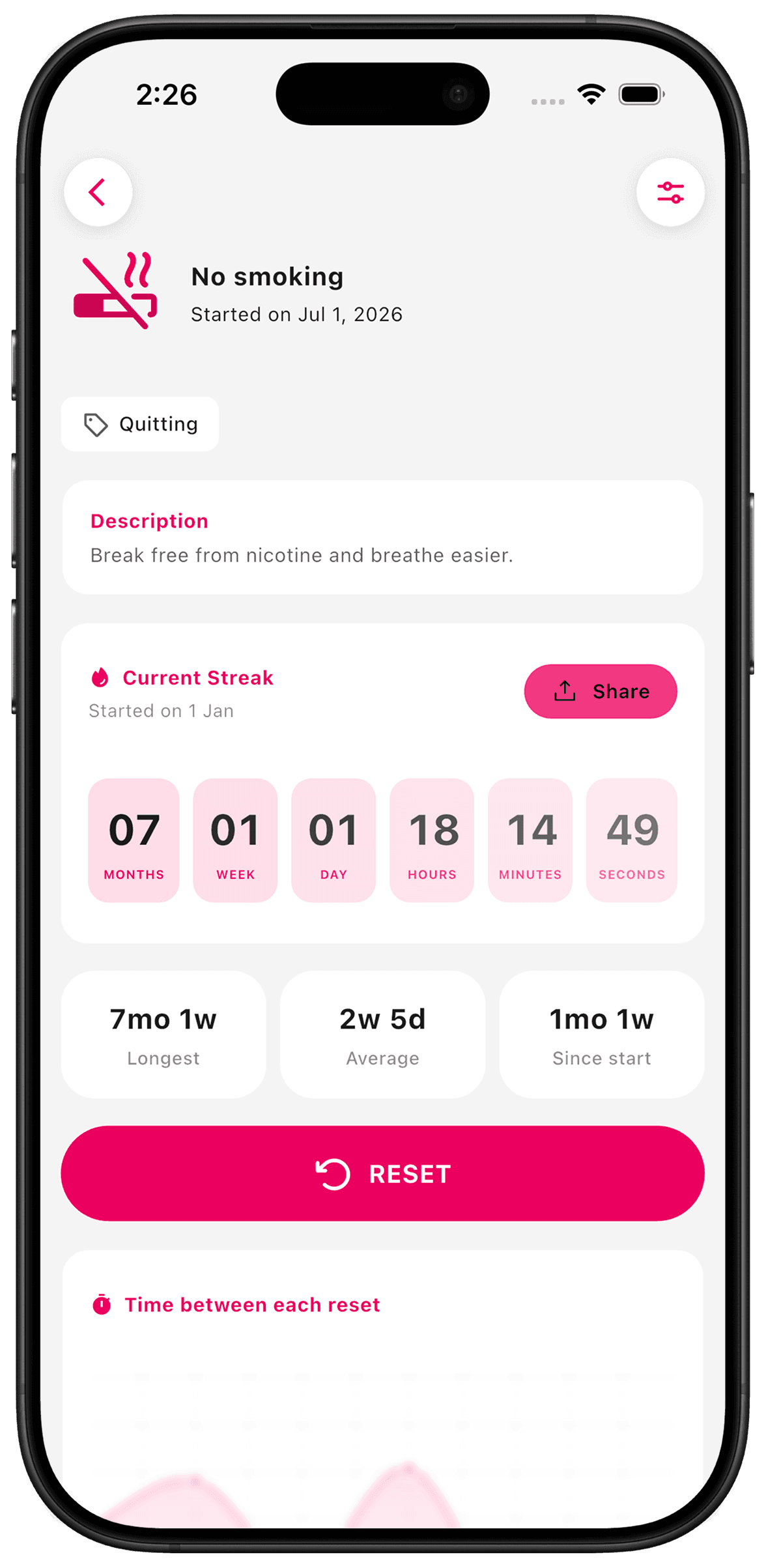
The short answer
Turn on Quitting mode for a counter and it climbs for as long as you stay away from something, rather than resetting when you log. If you slip, logging a reset starts the count again with no penalty and no lost history, and the calendar still shows the stretches between resets. It is the closest thing here to a streak, with the difference that a reset is a new line in your history rather than the erasure of everything before it. This is a record, not a treatment programme.
Everywhere else in this app, logging something resets its counter to zero: you did the thing, so the interval starts again. Quitting mode inverts that. The number climbs for as long as you stay away, and it only returns to zero when you say you slipped.
That is the one case where a climbing number is unambiguously the right shape.
What a reset actually does
It starts the count again. That is all.
Nothing is deleted, nothing is marked failed, and the stretches you already counted stay in the calendar. If you went eleven days, then slipped, then went nineteen, the record holds both — and the second number is the one that came after you restarted, which is the thing most worth knowing about yourself.
This matters because the alternative is what streaks do: return to zero and take the history with them, so that the price of one bad day is everything you had built. People do not usually lose one day to a broken streak. They lose the habit.
Why this one is allowed to climb
Asking for a streak on a habit you are building gets a deliberate no here. A quit counter is the exception, and the reason is that the thing being measured is genuinely cumulative.
Days since you last smoked is a real quantity. Days in a row that you remembered to stretch is a scoring system someone invented. The first describes the world; the second describes your compliance with a target. Only one of them is worth putting on a home screen.
Read the calendar, not just the number
The headline number tells you about now. The calendar tells you about the pattern, and the pattern is usually the more useful of the two.
Four stretches of eleven days reads very differently from one unbroken eleven. Both show "11" today. If you only look at the number, you cannot tell which one you are living in.
What this is not
It is a counter. It records what you tell it, and it shows you intervals.
It does not know what you are quitting. It cannot tell a slip from a pattern, it will not escalate, and it has no idea whether today's number is good news for you or not. If what you are quitting has physical withdrawal, or if it is affecting your health, work or relationships, this belongs alongside a clinician or a dedicated service rather than instead of one. The sources below are reasonable places to start.
Step by step
- 1
Create the counter and turn on Quitting mode
The counter now counts up from your last reset rather than resetting when you log. Quit counters are grouped into their own section so they do not sit among your chores.
- 2
Set the start to when you actually stopped
If you stopped three days ago, say so. A counter that starts today when you quit on Sunday is answering the wrong question from the outset.
- 3
Decide now what a reset means to you
Before you need it, not during. A reset is a factual log entry, and deciding in advance what counts keeps it from becoming a judgement call at the worst moment.
- 4
Add a reminder only if you want one
A reminder on a quit counter arrives with the time you have counted so far, whenever suits you. It asks nothing. If that would not help you, leave it off.
- 5
Look at the calendar, not just the number
The calendar shows the days between resets. Four stretches of eleven days is different information from one stretch of eleven, and only one of those is visible in the headline number.
What TimeSince helps with
- A number that climbs for as long as you stay away
- A reset that keeps every earlier stretch in your history
- A calendar showing the days between each reset
- Reminders that arrive without asking anything of you
What TimeSince will not fix
- It is not treatment, therapy, or a substitute for either
- It cannot tell you whether a slip is a pattern or a one-off
- It will not escalate, intervene, or contact anyone for you
- It does not know what you are quitting, or why
Frequently asked questions
What happens when I slip?+
You log a reset and the count starts again. Nothing is deleted, no history is lost, and there is no penalty applied. The earlier stretches stay in the calendar, so a reset adds a line to the record rather than wiping it.
Is this not just a streak?+
It is the closest thing here, and the difference is what a break costs. A streak returns to zero and takes the record with it. A quit counter returns to zero and keeps every stretch you have already counted, which is the part that makes starting again feel possible.
Can I keep a quit counter private?+
Yes, with Pro. Hidden counters sit behind Face ID or Touch ID in a layer masked from the main list, and they are not offered to widgets, which would otherwise put them on your lock screen.
Is this a recovery programme?+
No. It is a counter. It records what you tell it and shows you the intervals. If you are quitting something with physical withdrawal, or quitting matters medically for you, talk to a clinician or a dedicated service as well.
What this is based on
- Quit smoking — NHS
- Alcohol's effects on health — National Institute on Alcohol Abuse and Alcoholism
This is educational information, not medical, legal, or financial advice. For anything affecting your health or safety, talk to a professional.
Track it without the guilt trip
TimeSince counts the time since you last did something. No streaks to break.

Keep reading
Guide
Why Streaks Backfire (And What to Track Instead)
Streak counters reduce a habit to one number, then reset it to zero the first day life gets in the way. Here is why that model fights most habits, and what to measure instead.
Scenario
I want a streak counter. Why isn't there one?
Plenty of people find a streak motivating, and ask for one. The answer is a deliberate no, not an oversight, and there is something else to look at instead.